The Number in Your Head Is Not Your Business Value
Most business owners have a number in their head. The trouble is, very few know whether a buyer would agree.

Most business owners I talk to have a number in their head. Ask what their company is worth and they will give it to you without much hesitation. Ask where that number came from, though, and the answer gets fuzzy. Maybe it is what a friend at the club said his shop sold for. Maybe it is a multiple they read about once. Maybe it is simply what they hope.
Very few have had the business properly valued. What they are carrying around is an assumption, and assumptions have a way of falling apart at the worst possible moment.
Picture this. Someone walks into your office tomorrow and offers to buy the company. Cash. No games. Would you know what to say? Not the number you would like to hear. What is the business actually worth, on paper, to a stranger who has never met you and does not care how hard you have worked?
A lot of owners cannot answer that with confidence. Too many find out the truth sitting across the table from a buyer who is politely explaining that the thing they spent twenty years building is not worth what they thought.
Successful is not the same as significant
Almost every owner I meet has built something good. They make a nice living and take care of their families. They have created jobs, supported their communities, and built a product or service people need. Growth may not have been explosive, but it has been steady and real.
That is success, and it matters. But it is not the same thing as significance.
A successful business pays its owner well. A significant business is valuable in its own right. Someone else would want to own it, and it could keep running without you standing in the middle holding all the wires together.
The distance between those two is where owners get blindsided. So ask yourself: if you could not work anymore and your income stopped tomorrow, would the business still be worth something? Or would it stop the day you stopped showing up?
“A successful business pays its owner well. A significant business is valuable in its own right.”
The numbers most owners never see
I would rather let the research make this point than try to make it myself.
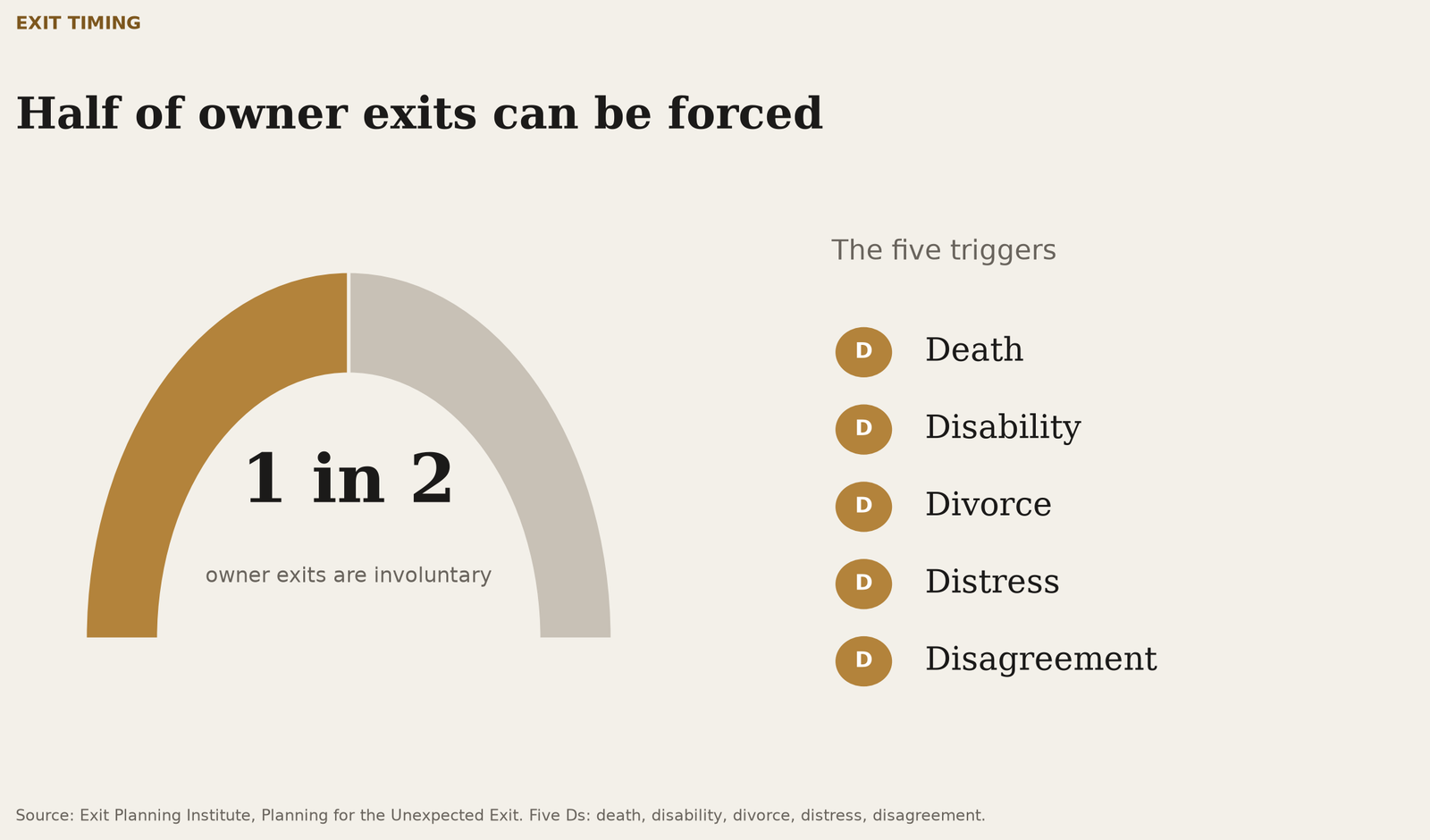
According to the Exit Planning Institute, roughly 80 percent of a typical owner’s net worth is tied up in the business. Not in a diversified portfolio. Not in real estate. In the company.
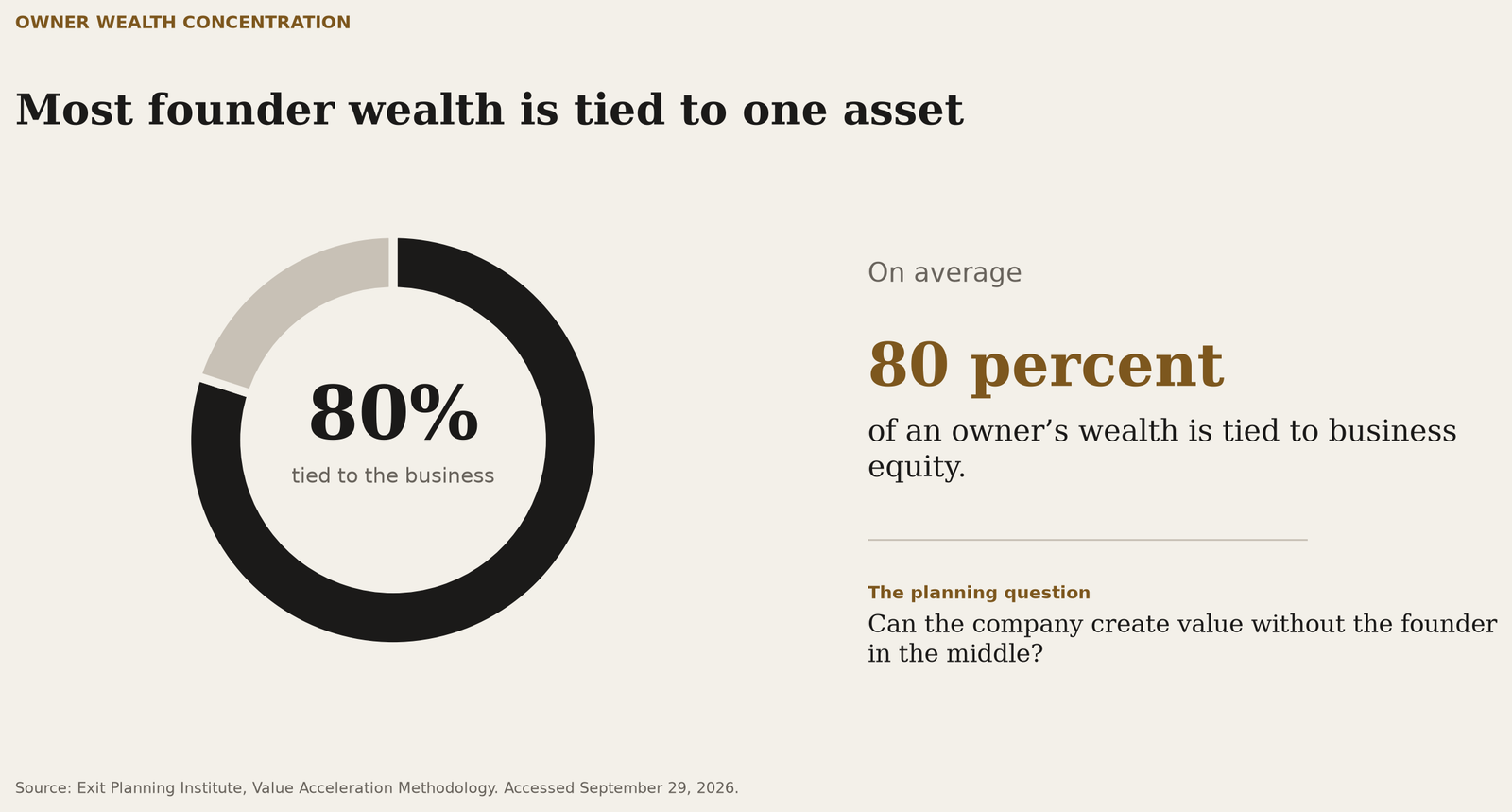
EPI’s earlier research found that 83 percent of owners had no documented transition plan. Their 2023 national study showed real progress, with 42 percent reporting a written, formal plan. That is encouraging, but it still means most owners do not have one.
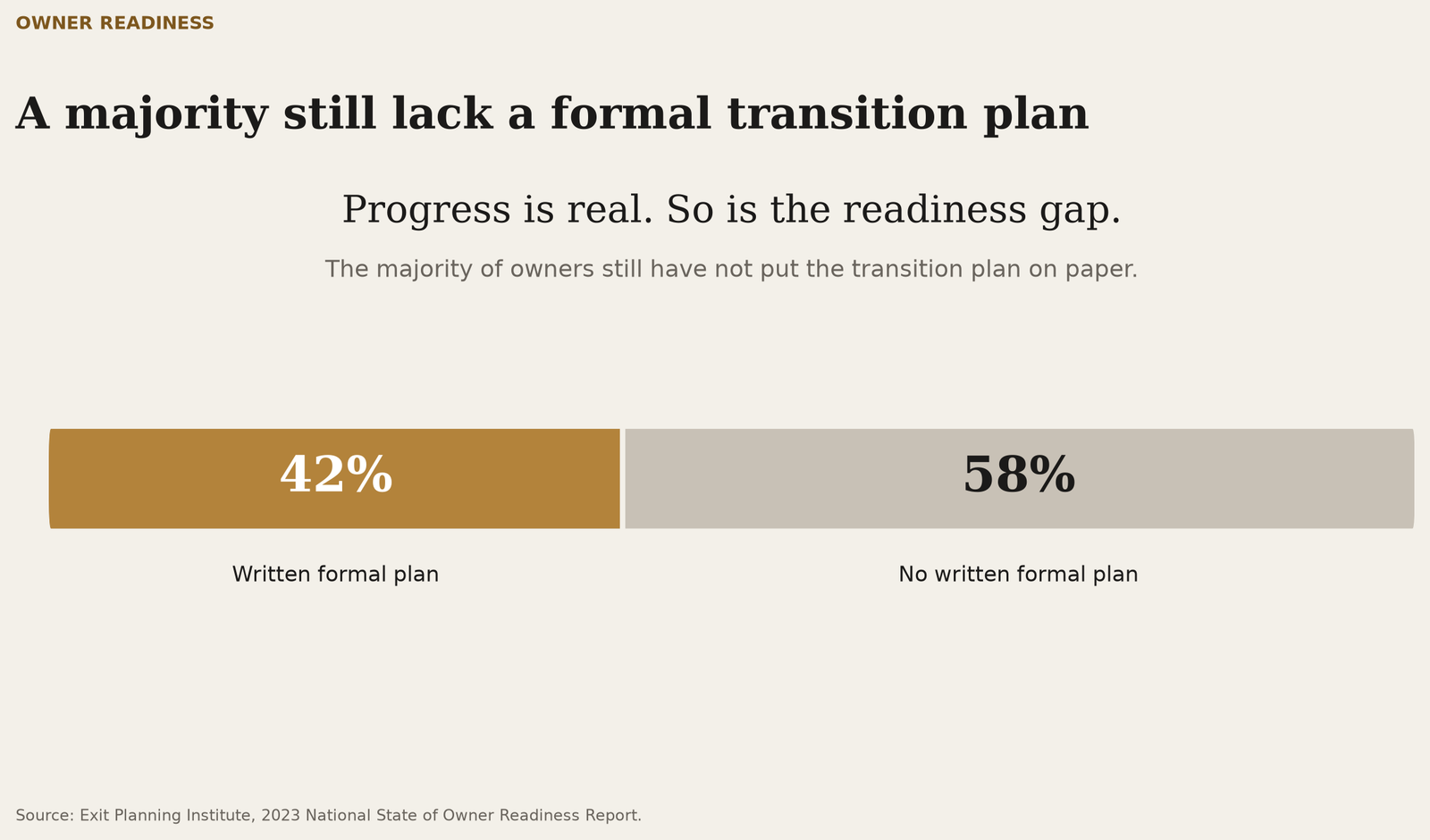
EPI also estimates that about half of all exits are forced. They happen because of death, disability, divorce, disagreement, or distress, and not on the owner’s timeline or terms. Life shows up first, and whatever plan existed goes out the window.
The statistic that stays with me most is this one. EPI often cites historical research suggesting that about 75 percent of owners experienced profound regret within a year of selling. Three out of four. Not five years later. Within twelve months.
That tells you selling a business is not only a financial event. It is tied up with identity, purpose, and what you do on a Tuesday morning when nothing depends on you anymore.
Three shifts in thinking
If you would like to stay out of those numbers, it starts with how you think about the business.
Exit strategy is business strategy. Most owners treat these as two separate projects, one for now and one for someday. They are not. Every decision you make today, from who you hire to how you document your processes to how much the business leans on you personally, is either building value or slowly draining it. That is true whether you are 35 or 65. The clock is already running.
Business is personal. I would never ask an owner to pretend otherwise. Your company supports your family, your employees’ families, and your community. That is not a weakness you need to hide from a buyer. It is the reason all of this matters.
Value is not the same as income. A healthy paycheck does not mean you have built a valuable, transferable company. Plenty of businesses pay their owners very well and would be worth almost nothing to anyone else the day that owner walked away. The good news is that the work of building transferable value tends to make the business stronger and less dependent on you right now.
So when you think about the future of your company, are you picturing a paycheck, or an asset you could sell, pass down, or step away from? Plenty of owners answer that question wrong and never notice.
Where the value really lives
This part surprises people. EPI’s framework holds that up to roughly 80 percent of a company’s value can come from intangible capital, which they break into four areas.
Human capital. How well you develop and keep good people, so the business is not one resignation away from a crisis.
Customer capital. How diversified and loyal your customer base is, so losing a single account does not threaten the whole operation.
Structural capital. How much of the business runs on documented systems rather than living in your head, where neither a buyer nor your own team can get to it.
Social capital. The culture and reputation you have built inside your walls and out in your market. It will not appear on a balance sheet, but it shows up in the sale price.
You are probably doing some of this already. The difference is doing it on purpose, with value in mind. When you do, the business gets healthier and more transferable today, and you strengthen whatever comes next, whether that is selling, keeping it, or handing it to your kids.
One more question worth sitting with. Of those four areas, people, customers, systems, and culture, which one have you been avoiding? Most owners know the answer right away. It is usually the one that makes them a little uncomfortable.
Let your life drive the business
The last idea may be the most important one.
A lot of owners operate on an unspoken sequence. Grow the business first. Then someday, maybe in your 50s or 60s, turn all that growth into wealth and freedom. Twenty, thirty, or forty years of putting it off.
Your life should drive your business, not the other way around.
Start by getting clear on what you want your life to look like. Not the version you have settled into because it was easier than asking the question, but the one you actually want. Then figure out what it costs. The difference between what you will need and what you have outside the business is what we call your wealth gap.
Once you know that number, you know exactly what the business has to become to close it. Now you have a plan with a real number attached instead of a vague hope.
If your business fully funded the life you want, what would you do differently starting Monday? Would you make different decisions this week if you already knew?
Where to go from here
You do not need every answer today. Most owners do not have them, and that is normal. But the ones who build significant businesses eventually do something most people avoid. They stop dodging these questions and sit down to answer them, even when the answers are uncomfortable.
If some of this made you uneasy, that is a good sign. It is usually where the real thinking begins.
If you would like a clearer picture of where your business stands today, including your real number, your real gap, and your real options, I would welcome that conversation. Let us find out what your business is actually worth and what it would take to move it from successful to significant.
Building a successful business is an accomplishment. Building a significant one, for you, your family, and whatever comes next, is the goal.
Important information
This material is for education and marketing purposes only. It is not individualized investment, legal, tax, valuation, or business succession advice. Consult qualified professionals who understand your circumstances before acting.
Quantum Leap works with a small number of founders and families through the years around a liquidity event. If this raised a question about your own situation, that is the point.